

Punjab Clean Gas and Biogas Project
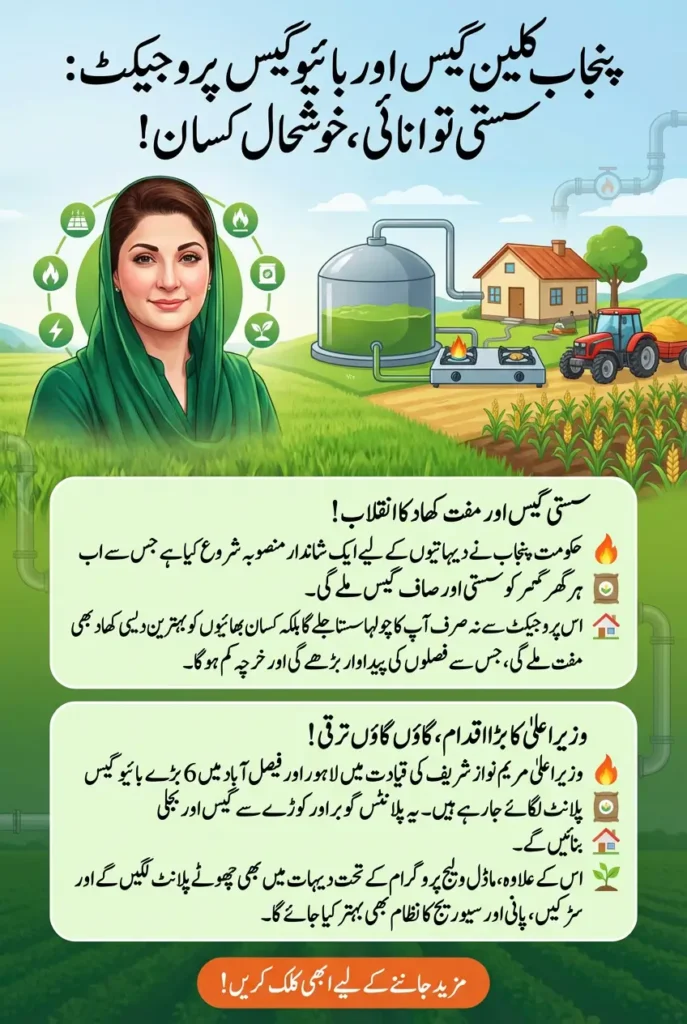
Punjab Clean Gas and Biogas Project: The Punjab Clean Gas and Biogas Project has been launched to provide cheap, clean, and sustainable energy for domestic use in the province. Chief Minister Maryam Nawaz Sharif approved the initiative, which focuses on using biogas technology to benefit households and farmers while promoting environmental sustainability. The project represents a significant step toward reducing reliance on conventional fuel sources and advancing the clean energy sector in Punjab.
This initiative will not only supply low-cost gas to homes but also create opportunities for producing bio-fertilizer for agricultural purposes. By integrating energy generation with environmental conservation, the Punjab Clean Gas and Biogas Project aims to create a model for sustainable energy solutions in rural and urban areas.
• Provides affordable domestic energy
• Supports farmers with bio-fertilizer
• Promotes clean and sustainable energy
Punjab Clean Gas and Biogas Project Approval Details
Chief Minister Maryam Nawaz Sharif approved six biogas plants as part of this project. Four plants will be established in Lahore, and two will be set up in Faisalabad. These biogas plants will convert organic waste into clean energy, ensuring that households receive an uninterrupted supply of low-cost gas.
The approval was made following a detailed briefing and feasibility study for small biogas plants. The project also includes plans for a multiple-fuel bio-refinery, which will further enhance energy production and provide additional benefits to the agricultural sector.
• Six biogas plants approved in total
• Four in Lahore, two in Faisalabad
• Feasibility study for small biogas plants
Islamabad Learner Permit at Checkpoints: How On-the-Spot
Role of Maryam Nawaz Sharif in the Punjab Clean Gas and Biogas Project
Chief Minister Maryam Nawaz Sharif chaired a special meeting on clean energy, where the project details were finalized. She emphasized the importance of providing affordable domestic energy while promoting environmental sustainability and rural development.
Her vision includes integrating biogas plants with the Model Village Program, ensuring that clean energy solutions reach the grassroots level. Maryam Nawaz also instructed the authorities to fast-track waste-to-energy projects to provide electricity for public transportation, including electric buses and metro systems.
• Chaired clean energy and development meetings
• Integrated biogas plants with the Model Village Program
• Advocated for waste-to-energy projects
Objectives of the Punjab Clean Gas and Biogas Project
The primary objective of the Punjab Clean Gas and Biogas Project is to provide households with low-cost domestic gas derived from organic waste. By producing energy locally, the project reduces dependence on conventional fuels and helps households save money on energy bills.
Another key objective is to support farmers by producing bio-fertilizer as a byproduct of biogas production. This not only improves crop yields but also reduces the use of chemical fertilizers, promoting environmentally friendly agricultural practices.
• Provides low-cost domestic gas
• Produces bio-fertilizer for agriculture
• Supports environmentally sustainable practices
Biogas Plants Development Under Punjab Clean Gas and Biogas Project
The project aims to construct biogas plants in key urban and rural areas to maximize energy output. The plants will use organic waste from households, farms, and industries to generate gas efficiently.
This clean energy approach ensures that waste is utilized effectively while reducing environmental pollution. The biogas plants are expected to operate as models for other provinces, demonstrating how sustainable energy solutions can be scaled successfully.
• Converts organic waste into gas
• Reduces environmental pollution
• Serves as a model for sustainable energy
Sui Gas Duplicate Bill Islamabad Check Northern Sui Gas Bill Easily
Waste-to-Energy Initiative Linked With Punjab Clean Gas and Biogas Project
A waste-to-energy project will be launched in Lahore to complement the biogas plants. This initiative will generate electricity from organic waste, which can be used to power electric and metro buses, reducing operational costs and carbon emissions.
The waste-to-energy project represents a significant step toward achieving a green energy transition. It also helps manage city waste efficiently while providing reliable electricity to public transport systems.
• Produces electricity from organic waste
• Powers electric and metro buses
• Supports a green energy transition
Model Village Program and Punjab Clean Gas and Biogas Project
Three pilot biogas plants have been included under the Model Village Program to ensure clean energy reaches rural areas. The first phase of the program focuses on providing water supply, drainage, street lights, parks, and footpaths in 469 villages.
By integrating energy projects with rural infrastructure, the program aims to improve the quality of life for villagers. Sustainable biogas plants ensure that even remote communities benefit from clean energy solutions.
• Pilot biogas plants included in Model Village Program
• Improves rural infrastructure
• Provides sustainable energy to villages
Feasibility Studies Approved Under Punjab Clean Gas and Biogas Project
Feasibility studies have been approved to assess small biogas plant projects and explore the potential for a multiple fuel bio-refinery. These studies will help design cost-effective solutions and identify the most efficient ways to implement energy production.
Authorities are also examining ways to integrate biogas production with waste-to-energy initiatives to maximize environmental benefits and financial efficiency.
• Small biogas plant feasibility studies approved
• Multiple fuel bio-refinery under review
• Focus on cost-effective and efficient energy production
SNGPL Bill Payment (Sui Northern Gas Pipelines Limited) Online
Infrastructure and Development Projects Reviewed Alongside the Punjab Clean Gas and Biogas Project
During the review meeting, Chief Minister Maryam Nawaz Sharif assessed ongoing projects, including the Punjab Development Program, Lahore Development Program, Model Village initiatives, PHA, Clean Water, and Rural Roads projects.
The meeting aimed to ensure that all development initiatives are synchronized and that infrastructure projects support the clean energy mission. Coordination between different departments is critical for timely and efficient project completion.
• Reviewed multiple development programs
• Ensured alignment with clean energy projects
• Emphasized timely project completion
Sewerage and Green Belt Infrastructure Decisions
Sewer lines are now being laid under green belts instead of roads to preserve city infrastructure. HOPE pipes with a lifespan of 100 years will be installed to ensure a sustainable drainage and sewerage system. Manholes will also be constructed alongside roads for maintenance.
These measures are designed to reduce excavation damage on streets and improve long-term urban infrastructure durability.
• Sewer lines under green belts
• HOPE pipes for 100-year durability
• Reduced road excavation damage
Housing and Loan Schemes Reviewed in the Meeting
Under the Apni Chhat and Apni Ghar schemes, 121,477 loans worth Rs 155 billion have been issued, and 65,000 houses have been completed. Currently, 700 houses are being built daily. Rs 5.15 billion has been received in installments, reflecting rapid progress in housing initiatives.
The Chief Minister emphasized the completion of ongoing construction and repair works, particularly sewerage systems and road rehabilitation, to minimize public inconvenience.
• 121,477 loans issued under housing schemes
• 65,000 houses completed, 700 under construction daily
• Focus on timely completion of construction projects
Road Construction and Rehabilitation Projects in Punjab
| Project Type | Progress |
|---|---|
| Road Rehabilitation | 4031 km constructed and repaired |
| New Construction | Projects worth Rs 204 billion launched in 52 cities |
| Water Supply | Bottling and filtration plants for South Punjab districts |
Road rehabilitation and new construction projects are being executed to enhance urban mobility and public safety. These projects include repair and reconstruction of roads, sewerage installations, and sustainable urban development initiatives.
Clean Water and Bottled Water Projects in South Punjab
Water bottling plants and filtration plants are being established to provide safe drinking water in districts like DG Khan, Khushab, Rahim Yar Khan, and Bahawalpur. The project aims to deliver bottled water directly to households, reducing the need to travel long distances for potable water.
The Chief Minister set a target for completing these facilities by June 30, ensuring timely access to safe water for residents.
• Bottled water for water-scarce districts
• Water filtration plants installed
• Completion target: June 30
Complete Procedure for Applying Online for Sui Gas Meter Installation